
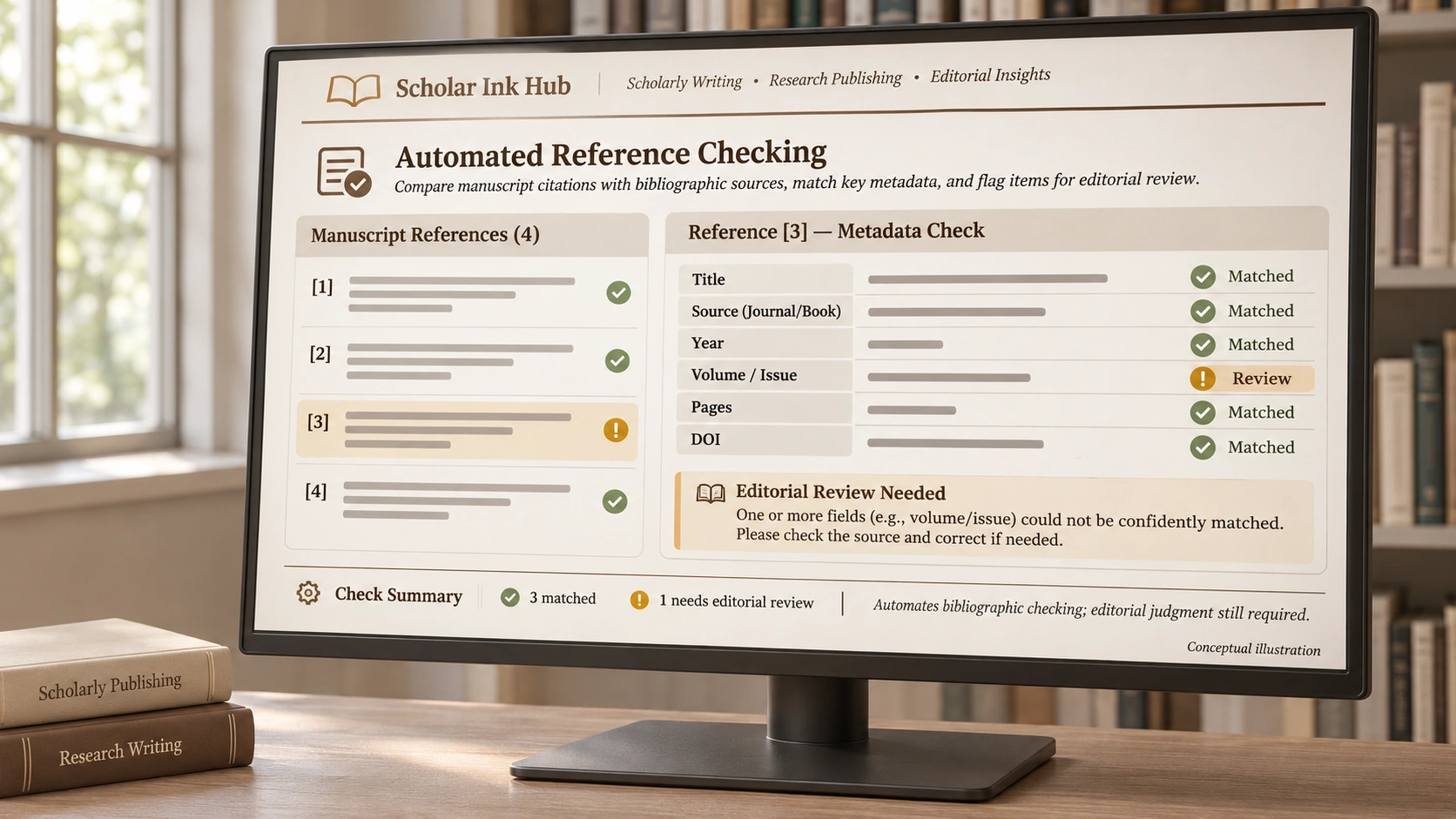
Introduction: A Correctly Formatted Reference Is Not Necessarily a Correct One
References are essential to scholarly publishing. They connect a manuscript to earlier research, allow readers to trace evidence, acknowledge previous contributions, and support the credibility of academic arguments. Yet reference checking remains a time-consuming part of manuscript preparation and editorial production.
A reference may contain a misspelled author name, an incorrect publication year, a missing page range, an invalid digital object identifier (DOI), or a journal title that does not match the original record. More importantly, a perfectly formatted reference may still fail to support the claim for which it is cited.
As journals and publishers process increasing volumes of manuscripts, automated reference-checking tools offer an opportunity to improve efficiency and consistency. They can compare bibliographic information against databases, identify missing fields, flag suspicious identifiers, and detect some citation inconsistencies.
But automation has limits. A system may confirm that a paper exists without determining whether it supports the author’s argument. It may identify a reference as unusual without understanding a legitimate variation in publication history.
The real opportunity is not to replace editors with automated reference checks. It is to let technology handle verifiable routine tasks so editors can focus on accuracy, relevance, and scholarly meaning.
On This Page
Why Reference Checking Matters in Scholarly Publishing
References perform several functions beyond completing a manuscript’s bibliography.
They establish the context for a study, recognize previous work, support methodological decisions, and allow readers to investigate the evidence behind important claims. Inaccurate references make that process more difficult and can weaken the reliability of a scholarly article.
Reference errors may also create problems during indexing, linking, and digital distribution. Incorrect metadata can prevent readers from reaching the intended article or cause citation links to point to the wrong record.
For publishers managing large editorial workflows, manual verification of every bibliographic detail can consume considerable time. Automation can help reduce repetitive work, provided that the tools are used for the checks they can perform reliably.
What Automated Reference-Checking Technology Can Validate
1. Bibliographic Metadata
A reference usually contains several identifiable elements, including author names, article title, journal or book title, publication year, volume, issue, page range, and publisher information.
Automated tools can compare these fields with records in bibliographic databases, publisher platforms, library catalogues, or other available metadata sources.
For example, a system may identify that the manuscript lists a publication year that differs from the year recorded by the publisher. It may also detect a missing journal title, an incomplete page range, or an author-name discrepancy.
These checks can help editors locate errors quickly. However, a metadata mismatch does not always mean the manuscript is wrong. Online-first publication dates, print publication dates, corrections, supplements, and different citation styles can create legitimate differences.
The system should flag discrepancies for appropriate review rather than automatically replacing information without considering the publication’s requirements.
2. DOI and Identifier Validation
Digital object identifiers are widely used to identify scholarly publications. Automated tools can check whether a DOI follows the expected format and whether it resolves to a record.
A successful resolution, however, proves only part of what needs to be verified. The resolved record should also match the intended work.
For example, a DOI may be valid but belong to a different article. A reference could therefore pass a basic identifier check while still directing readers to the wrong source.
A stronger workflow compares the resolved title, authors, publication details, and other available metadata with the reference in the manuscript.
Not every scholarly work has a DOI, so the absence of one should not automatically be considered an error. Books, older publications, reports, and some regional or specialist sources may use different identifiers or none at all.
3. Missing or Incomplete Reference Fields
Automated checks can identify references that appear to be missing required elements. Depending on the citation style, this may include an article title, publication year, journal name, volume, issue, page range, publisher, or identifier.
Such checks are particularly useful during copyediting and reference formatting, where small inconsistencies can accumulate across a long bibliography.
The system should account for the type of source. A journal article, book chapter, website, dataset, preprint, and conference paper do not necessarily require the same fields.
Validation rules should therefore be aligned with the journal’s reference style and the metadata normally available for each source type.
4. Duplicate References
A manuscript may accidentally include the same source more than once, particularly when references are imported from different reference managers or combined from several drafts.
Automated comparison can identify entries with matching identifiers, titles, or similar bibliographic information.
Duplicate detection is useful, but it must account for legitimate cases where the same research appears in different forms, such as a preprint and a final published version. Whether these should be cited separately depends on the context and journal policy.
Editors should confirm that apparent duplicates genuinely refer to the same work before merging or removing entries.
5. Citation and Reference-List Consistency
A manuscript may cite a source in the body text but omit it from the reference list. Conversely, the bibliography may contain entries that are never cited.
Automated tools can compare in-text citations with the reference list and flag unmatched entries. They can also detect some numbering inconsistencies in numbered citation styles.
These checks are especially valuable after revisions, when adding or removing a paragraph can affect citation numbering and reference order.
However, the system must understand the manuscript’s citation style and structure. Citations in tables, figure captions, footnotes, supplementary files, or reference-management fields may require specialized handling.
What Technology Cannot Reliably Decide on Its Own
Whether a Reference Supports the Claim
This is one of the most important limitations of automated reference checking.
A reference can be genuine, correctly formatted, and linked to the right article while still being inappropriate for the claim it accompanies.
For example, a manuscript may cite an observational study to support a strong causal conclusion, or use a source about one population to make a broad claim about another. A metadata-validation tool may not identify these problems because the reference itself is valid.
Assessing whether a source actually supports a statement requires understanding the claim, the evidence, and the source’s findings and limitations. Depending on the subject, this may require an editor or specialist reviewer.
Whether the Source Is Scientifically Reliable
A published article is not automatically reliable evidence for every purpose. Its methods may have limitations, its findings may have been challenged, or a correction or retraction may have been issued.
Some systems can check available retraction or correction information, but database coverage and update timing vary. A missing alert does not guarantee that a source has no integrity concerns.
Editors should examine relevant notices and assess the source in context, particularly when it supports a central claim, clinical recommendation, or important methodological decision.
Whether the Citation Is Appropriate and Fair
Citation quality is not only a matter of metadata accuracy. Authors must represent previous research fairly and acknowledge relevant contributions appropriately.
Automated systems may detect unusual citation patterns, but they cannot always determine whether a citation is necessary, whether an important source has been overlooked, or whether the discussion misrepresents another researcher’s conclusions.
These questions require editorial judgment and, in some cases, specialist knowledge.
Whether an Unusual Reference Indicates Misconduct
A reference that cannot immediately be located may be incomplete, incorrectly transcribed, poorly indexed, published in another language, or recorded under a different title. It may also be inaccurate in a more significant way.
The correct response is to investigate the discrepancy rather than infer misconduct from a failed database search alone.
This distinction is important for fairness, particularly when manuscripts cite older literature, regional publications, specialist proceedings, or resources that are not comprehensively indexed.
Designing an Effective Automated Reference-Checking Workflow
Step 1: Extract and Structure the References
Before validation, the system must identify individual references and separate their bibliographic fields.
This may involve parsing Word documents, PDFs, XML files, or references exported from a citation manager. Poor formatting, scanned documents, unusual punctuation, and mixed citation styles can affect extraction accuracy.
A robust workflow should identify references that could not be parsed confidently and route them for manual review rather than treating incomplete extraction as a reference error.
Step 2: Match References Against Reliable Records
Use suitable metadata sources to compare the extracted references with available records. Matching can rely on identifiers, titles, author names, publication years, or combinations of fields.
Exact matches are generally easier to validate than records with incomplete or inconsistent metadata. Fuzzy matching can help identify likely matches, but it should account for similar titles and publications that may be easily confused.
When the system finds multiple plausible matches, it should present the alternatives for review rather than selecting one without sufficient confidence.
Step 3: Apply Journal-Specific Rules
Different journals use different citation styles and requirements. A reference that is acceptable under one style may need changes under another.
Configure validation rules for the journal’s required punctuation, author-name conventions, abbreviations, ordering, DOI presentation, and source-specific fields.
Where reference formatting is automated, preserve the underlying bibliographic data and make changes traceable. This reduces the risk of a formatting correction introducing a new metadata error.
Step 4: Generate an Actionable Error Report
A useful report should distinguish among different types of problems, such as:
- Missing required metadata.
- DOI or identifier that does not resolve.
- Identifier that resolves to a different publication.
- Duplicate or potentially duplicate references.
- In-text citations that do not match the reference list.
- References requiring manual verification.
Reports should provide enough detail for editors to understand the discrepancy and decide what to do next. A long list of unexplained warnings can create more work instead of reducing it.
Step 5: Route Uncertain Cases to an Editor
Automated systems should distinguish between high-confidence validation results and uncertain matches.
A clearly missing required field may need a routine correction. A DOI that resolves to the wrong article requires investigation. A reference that appears to contradict a central claim may need subject expertise.
A risk-based process helps editors focus their time where judgment matters most while allowing straightforward corrections to be handled efficiently.
Step 6: Recheck References After Manuscript Changes
References often change during revision, copyediting, and production. A new paragraph may introduce additional citations, an author may replace a source, or a correction may affect the numbering of the bibliography.
Reference checking should therefore be repeated at appropriate stages, especially after substantial changes and before publication.
The final check should confirm both bibliographic consistency and the correct rendering of reference links in the publication’s intended formats.
How AI Can Support Reference Checking
AI can assist with extracting references from irregular documents, matching likely records, identifying unusual citation patterns, and summarizing differences between manuscript entries and external metadata.
It may also help editors locate claims that appear to need citations or identify places where a reference’s relevance deserves closer examination.
However, AI-generated suggestions must be validated. A system may propose an incorrect source, misinterpret a title, or produce a plausible explanation that is not supported by the underlying record.
Publishers should also consider confidentiality when selecting tools, particularly when manuscripts are unpublished or subject to contractual restrictions.
The most reliable workflow combines structured metadata validation with human review, rather than asking a general-purpose AI system to declare that a bibliography is correct.
Measuring the Value of Automation
Publishers should evaluate reference-checking systems based on the quality of the results, not simply the number of errors detected.
Useful indicators include the percentage of references matched confidently, the number of confirmed metadata errors, the frequency of false alerts, the time editors spend resolving discrepancies, and the number of reference problems discovered after publication.
These measures can reveal whether the system is reducing repetitive work or merely transferring the workload to editorial staff.
Regularly updating validation rules and reviewing common error patterns can improve performance over time.
Conclusion
Automated reference checking can make scholarly publishing more efficient by validating metadata, checking identifiers, detecting duplicates, and identifying inconsistencies between citations and reference lists.
Yet technical validity is not the same as scholarly validity. Technology cannot reliably determine every time whether a source supports a claim, whether evidence has been represented fairly, or whether a citation is appropriate in its research context.
The strongest approach combines reliable metadata sources, journal-specific validation rules, actionable reports, and editorial judgment.
Automation should make reference checking faster and more consistent—not remove the human responsibility to ensure that scholarly claims are supported by the right evidence.